Museums/History

Historical Marker - Aurora

Dr. Wilhelm Keil founded here a Christian co-operative colony patterned after his colony at Bethel, Missouri. Musicians of the settlement made it widely famous. After Dr. Keil's death in 1877 the communal enterprise was dissolved.

Historical Marker - Beacon Rock

The prominent monolith across the river was named Beacon Rock by Lewis and Clark, November 2, 1805. It marked the beginning of tidewater for early river explorers who used it for a landmark in their journeys. The Indians say that when the Chinook Winds blow softly up the river one can hear the wailings of unhappy, beautiful Wahatpolitan, the Indian maid who climbed the rock and perished with her child, when given to a chief other than the one she loved.
 

Historical Marker - Boone's Landing

Many of Oregon's early transportation routes resulted from the efforts of enterprising pioneers like the Boone family of Clackamas County. In 1846 Alphonso Boone, grandson of Daniel Boone, emigrated to Oregon via the Applegate Trail with his large family. By 1847, using local Tuality Indians as oarsmen, they established Boone's Ferry near this marker. The thriving community of Boone's Landing, genesis of Wilsonville, quickly sprang up on the river's north shore. The same year, eldest son Jesse began clearing a path, called Boones Ferry Road, connecting Portland with Salem.

Historical Marker - Broughton's Expedition

Captain George Vancouver in a voyage of exploration to the northwest coast of America ordered by the British Admiralty Office assigned Lieutenant William Robert Broughton, Commander of H.M.S. Chatham, to explore the navigable waters of the Columbia River with boat crews from his ship. This point marks the farthest inland reached by Broughton who camped overnight on an island within sight of this point on October 30, 1792.

Historical Marker - Brownsville

A TOWN WITH ANCIENT BEGINNINGS AND MANY NAMES

Long before the first pioneer settlers arrived here in the 1840's, this area was occupied by the ancient Mound Builders and then the Kalapuya Indians. The relative ease of finding food in the valley made the Kalapuya vulnerable to intruders, including other tribes, because they did not need to fight or go very far for food. At the time of Lewis and Clark, about two thousand were distributed in forty villages in the valley.

Historical Marker - Camp Adair

SITE OF THE CANTONMENT WHERE THESE DIVISIONS TRAINED DURING WORLD WAR II.

70TH INFANTRY DIVISION TRAILBLAZER DIVISION 274th, 275th and 276th Inf. Regts; 882nd, 883rd, 884th (I) and 725th (M) FA Bns. Attached to Seventh Army. Action in Saar Region. Maj. Gen. John E. Dalquist and Allison J. Barnett, Commanding Generals.

Historical Marker - Cannon Beach

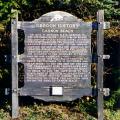
Lt. Neil M. Howison, U.S.N., arrived in the Columbia River 1 July, 1846 on board the 300-ton United States Naval Survey Schooner "Shark" for the purpose of making an investigation of part of the Oregon Country. His report was instrumental in creating public interest in the Oregon Territory and formulating a decision on the location of the boundary between English and American lands.

Historical Marker - Canyon Creek

The narrow gorge of Canyon Creek has long served as a travel corridor. Native Americans likely trekked this canyon for thousands of years. Alexander McLeod of the Hudson's Bay Company provided the first written account of the route in 1829, while traveling from Fort Vancouver on the Columbia River to California's central valley. The U.S. Exploring Expedition, under Lt. George Emmons, followed the trail in 1841 making scientific observations.

Historical Marker - Cape San Sebastian

Spanish navigators were the first to explore the North American Pacific Coast, beginning fifty years after Columbus discovered the western continents. Sebastian Vizciano saw this cape in 1603 and named it after the patron saint of the day of his discovery. Other navigators Spanish, British, and American followed a century and a half later.

Historical Marker - Champoeg State Park

Established as Provisional Government Park in 1913 to commemorate May 2, 1843 meeting of the "Inhabitants of the Willamette Settlements" to organize a civil government. The Organic Act, adopted July 5, 1843, was a Provisional Constitution for the Oregon Country, the first American Government on the Pacific Coast.

Subscribe to Museums/History